

Blackest Black: Vantablack and Ultra-Black Paints

The blackest black is not a single universal color: it can mean a record-setting research material, a specialist coating, an artist paint, or the standardized black value used in digital color. The darkest reported option in the reviewed primary evidence is an MIT carbon-nanotube structure, but it is not paint you can simply brush onto a craft project. This comparison separates the headline numbers from the practical choices so you can identify what is genuinely usable.
What Is the Blackest Black?
Among the materials covered here, the lowest reported visible-light reflectance belongs to a carbon-nanotube structure developed at MIT in 2019. The researchers reported absorption of at least 99.995%, which corresponds to no more than about 0.005% reflected under the stated measurement conditions.
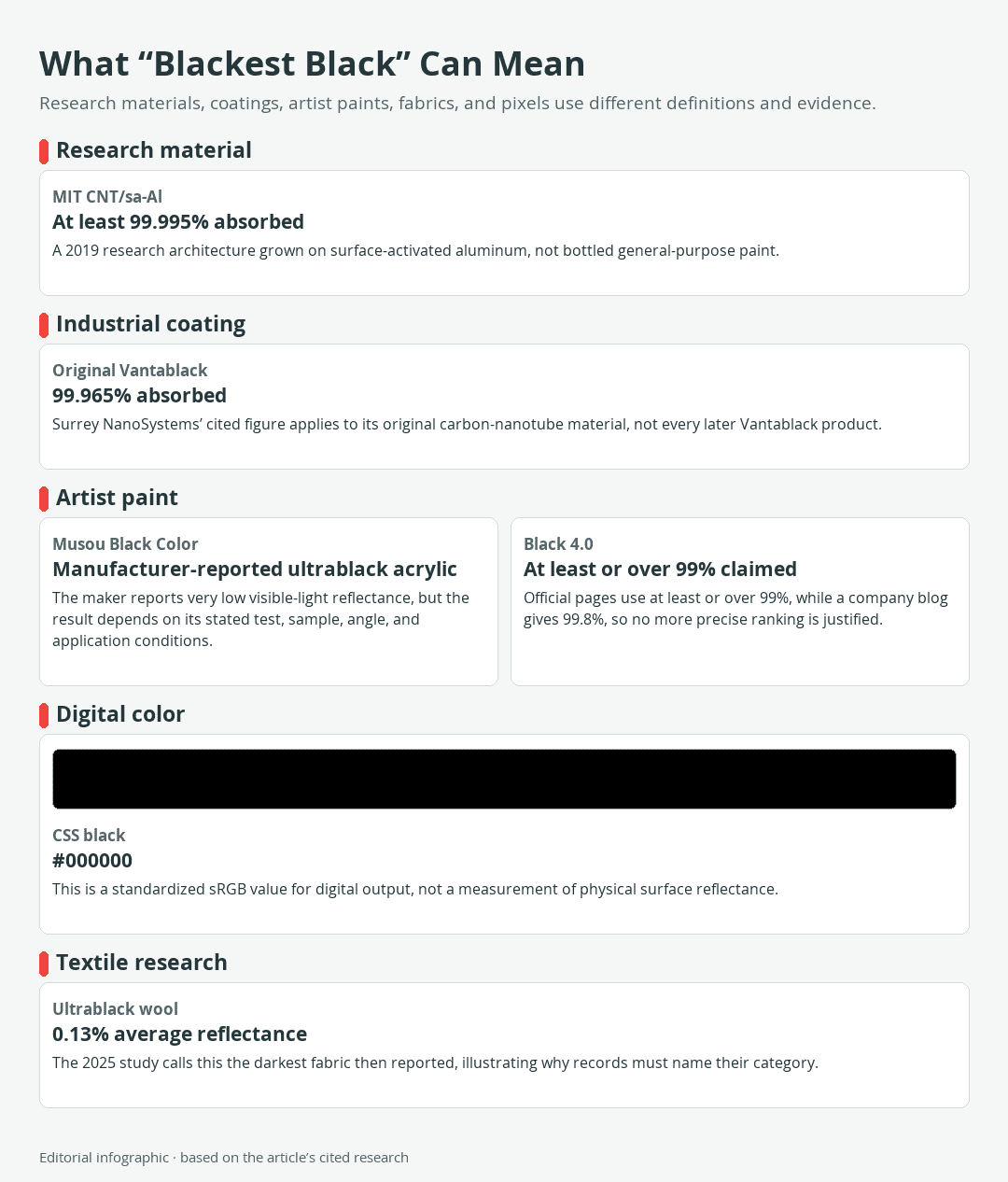
Download the complete color reference sheet (PNG): What “Blackest Black” Can Mean (PNG)
That does not make it a universal black paint. The material consists of carbon nanotubes grown on surface-activated aluminum, so it belongs to a different category from bottled acrylics. Original Vantablack is another carbon-nanotube material, with its manufacturer citing 99.965% absorption. Musou Black and Black 4.0 are more accessible water-based acrylic paints, although their published figures are manufacturer claims rather than one set of directly comparable independent measurements.
| Candidate | Material and evidence | Reported optical figure | Application and access | Handling or durability | Suitable use and key limitation |
|---|---|---|---|---|---|
| MIT CNT/sa-Al | Carbon-nanotube research structure on activated aluminum; supported by an institutional report and peer-reviewed research | At least 99.995% absorption | Nanotubes grown on prepared aluminum; not general-purpose paint | Ordinary user-handling performance is not specified in the reviewed record | Specialist research and optical applications; unavailable as a craft coating |
| Original Vantablack | Vertically aligned carbon-nanotube material; manufacturer-cited figure | 99.965% absorption | Specialist industrial technology grown in place on a surface | Properties differ across the Vantablack coating family | Engineered low-reflectance work; not bottled artist paint |
| Musou Black Color | Water-based acrylic paint; manufacturer-reported performance | The maker reports very low visible-light reflectance, with performance tied to its stated test, sample, and application conditions | Sold as artist paint; several thin coats are recommended, with airbrushing identified as the best-performing route | Pressure, abrasion, and moisture can reduce the dried surface’s performance | Controlled indoor art, models, props, and reflection control; the finish is delicate |
| Black 4.0 | Water-based artist acrylic; official manufacturer pages use inconsistent precision | Official pages claim at least or over 99% absorption, while a company blog gives 99.8% | Sold as artist paint; the maker specifies thin coats and drying intervals | Not presented as a permanent outdoor finish; varnish, resin, or clear coating adds shine | Indoor or temporary art and props; the ultramatte effect cannot be preserved with a conventional clear coat |
| CSS black | Standardized digital sRGB color | #000000, with RGB channels 0, 0, 0 | Used in digital design rather than applied as a physical coating | Physical handling and durability do not apply | Standard digital black; it does not describe material reflectance |
The qualified answer is therefore straightforward: the MIT structure has the lowest reported figure among these physical materials, original Vantablack is a specialist ultrablack coating technology, and Musou Black or Black 4.0 is the more realistic category for most artists and makers.
Blackest Blacks Compared by the Same Criteria
A fair comparison needs more than one dramatic absorption percentage. Material class, test method, application route, access, and durability determine whether a black is suitable for a laboratory instrument, sculpture, model, photograph, or handled prop.
 AI-generated editorial illustration; not a measured color sample.
MIT CNT/sa-Al Material
The MIT material combines carbon nanotubes with surface-activated aluminum. The aluminum’s native oxide was broken down before nanotube growth, allowing the researchers to create a hierarchical nanotube-metal structure. The work reported exceptionally low optical and infrared reflectance as well as absorption over a broad range of viewing directions.
Its strongest distinction is the reported minimum reflectance, not convenience. This is a manufactured research architecture tied to a particular substrate and process. It should not be described as a pigment, a bottled color, or a recipe that can be reproduced by mixing ordinary paints.
Original Vantablack
Original Vantablack also uses vertically aligned carbon nanotubes. Light entering the nanotube forest is repeatedly scattered and absorbed, leaving very little to return to the viewer. The original material’s cited 99.965% absorption figure is impressive, but it applies to that particular technology rather than every product carrying the Vantablack name.
Vantablack is now a family of specialist coating technologies with different spectral, reflectance, application, and durability characteristics. The original nanotube material is grown in place on a surface. It is not conventional pigment powder dispersed in an acrylic binder, and it is not equivalent to an artist’s jar of matte black paint.
Musou Black Color
Musou Black Color is a water-based acrylic paint intended for applications such as artwork, models, props, and reflection control. Its manufacturer reports very low visible-light reflectance, but that performance must remain tied to the maker’s stated wavelength, angle, sample, application, and reference-value qualifications rather than treated as a universal result.
Application and handling matter. The maker recommends several thin coats on a clean, preferably primed surface and says airbrushing produces the best optical result. The dried microtextured surface is delicate: pressure, abrasion, and moisture can reduce its absorption performance. This makes it useful where appearance matters more than resistance to touching or weather.
Black 4.0
Black 4.0 is another water-based artist acrylic that can be applied without carbon-nanotube growth equipment. Current official pages claim at least or over 99% absorption, while a company blog gives 99.8%. Without a consistent specification and an independent like-for-like test, Black 4.0 cannot be placed at an exact decimal position in a reliable ranking.
Its practical appeal is accessibility. The manufacturer describes thin coats, a substantial drying interval between coats, and indoor rather than permanent outdoor use. It also warns that varnish, resin, or another clear coating adds shine and weakens the ultramatte effect.
Why the Numbers Are Not One Simple Ranking
Absorption Versus Reflectance
Absorption is the portion of incoming light retained by a material. Reflectance is the portion that returns from it. Published product figures do not always describe identical tests, so apparently similar percentages may not be directly comparable.
Total hemispherical reflectance measures light reflected into the full hemisphere above a surface, commonly with an integrating sphere. It includes light scattered in many directions. A narrower measurement may instead emphasize light returned toward a particular detector position.
Reflection also has diffuse and specular components. Diffuse reflection spreads light broadly, while specular reflection produces a more mirror-like response or highlight. Two materials can have similar average darkness under soft lighting yet behave differently when a lamp, camera, and viewer line up at a revealing angle.
Wavelength and Viewing Geometry
A percentage measured at one wavelength is not automatically equivalent to an average covering the entire visible spectrum. The angle at which light strikes the surface, the angle from which it is observed, and whether the illumination is concentrated or diffuse can all change the recorded result. Coating thickness, substrate preparation, texture, and application method add further variables.
A 2026 research preprint illustrates this problem by comparing angular scattering from Vantablack, Musou paint, fabrics, and conventional black coatings. In its test set, Vantablack and Musou fabric produced the lowest total hemispherical reflectance. Musou paint suppressed specular response better than the ordinary coatings but reflected more than the ultrablack and fabric classes. Because the work is a preprint, it is best treated as recent comparative evidence rather than settled consensus.
Manufacturer Claims Versus Comparable Measurements
A manufacturer’s optical figure can be useful when selecting and applying that specific product, especially when the wavelength and measurement geometry are disclosed. It does not establish a universal rank against products tested by other laboratories with different instruments and samples.
This is why Black 4.0 is described here using the range of language found across its maker’s current pages rather than assigned the most precise promotional number. It is also why Musou Black’s exact percentage is omitted when all of the manufacturer’s angle, sample, application, and reference-value qualifications cannot be reproduced alongside it. Decimal places imply a level of comparability that the available records do not support.
Which Ultra-Black Should You Use?
Art, Models, and Props
Musou Black is a practical candidate for controlled indoor work when you want pronounced loss of reflected light and can protect the surface from contact and moisture. Its manufacturer’s airbrush recommendation makes it particularly relevant to detailed models and evenly coated forms, provided the substrate and work area are suitable for spraying.
 AI-generated editorial illustration; not a measured color sample.
Black 4.0 offers another accessible acrylic option for indoor or temporary pieces. It can suit artwork and props that need an extremely matte appearance but not a hard, clear-coated finish. Neither paint should be chosen solely because one promotional percentage appears fractionally higher than another.
Photography and Stray-Light Control
An ultramatte artist paint may help reduce visible reflections in a controlled photographic setup, display box, or noncritical model interior. The selected product still needs to match the wavelength range, angle, and durability demands of the job.
Precision optical equipment is a different category. A paint that appears black to the eye may reflect more at another wavelength or viewing angle. Use the engineering specification required by the instrument rather than substituting an artist acrylic on the strength of a headline visible-light percentage.
Projects That Need Durability
Choose cautiously when a surface will be touched, rubbed, exposed to moisture, or covered with resin. Musou Black’s maker warns that pressure, abrasion, and moisture affect its delicate surface. Black 4.0’s maker does not describe it as a permanent outdoor finish and says clear finishes add unwanted shine.
A less extreme but more durable matte coating can be the better design choice for furniture, wearable pieces, frequently handled props, or exterior work. The darkest initial finish has little practical value if normal use quickly burnishes, marks, or exposes it.
Applying an Ultra-Black Artist Paint
Preparation
Begin with the current instructions for the exact paint and substrate. Use a clean, dust-free, compatible surface and apply the primer or sealer specified by the manufacturer.
Thin Coats and Drying
Follow the selected manufacturer’s instructions for thin, even coats. Musou Black’s manufacturer says the application method changes performance, recommends several thin coats, and identifies airbrushing as its best-performing route.
For Black 4.0, the current manufacturer FAQ calls for at least two hours between thin coats and says leaving a coat overnight is preferable. These timings belong to that product, not to all ultra-black paints, so follow the current label for the material you use.
If spraying or airbrushing, consult the product’s safety information before starting. Use the ventilation, respiratory protection, eye protection, and overspray controls it specifies, and keep other people and animals out of the controlled spray area.
Handling the Finished Surface
After the final coat, allow the full period stated by the manufacturer before moving the piece. Handle it by unpainted supports or protected edges whenever possible. Rubbing an ultramatte surface can leave a more reflective mark against the surrounding black.
Do not assume a clear coat will protect the finish without changing it. A varnish or resin layer creates a new optical surface that can restore highlights. Black 4.0’s maker explicitly warns against this approach, while Musou Black’s performance also depends on preserving its delicate matte structure.
Blackest Black HEX Code and Screen Limits
Standardized Digital Black and White References
The standardized CSS named color black is #000000, with red, green, and blue channels set to zero. CSS white, #FFFFFF, provides the standardized opposite endpoint for this digital comparison. These references describe sRGB color values, not physical coatings.
 AI-generated editorial illustration; not a measured color sample.
| Name | HEX | RGB | Color |
|---|---|---|---|
| CSS black | #000000 | 0, 0, 0 | |
| CSS white | #FFFFFF | 255, 255, 255 |
White is included as a digital comparison reference, not as another candidate for the blackest physical material. Neither digital value specifies how much light a painted, coated, or textile surface reflects.
Why Physical Ultrablacks Have No Exact HEX Equivalent
MIT’s CNT material, original Vantablack, Musou Black, Black 4.0, and ultrablack wool do not have standardized universal HEX codes. HEX specifies channel instructions within a digital color system. It does not encode a coating’s texture, wavelength-dependent reflectance, viewing angle, application thickness, or response to physical illumination.
Assigning slightly different near-black HEX values to those materials would create false precision. A digital swatch cannot reproduce the angle-dependent reflectance of a physical ultrablack surface. For digital work, use #000000 when the design calls for standardized sRGB black.
Why “Blackest” Depends on the Material Category
A 2025 study reported ultrablack wool with average total reflectance of 0.13% across the visible range from 400 to 700 nm. The researchers described it as the darkest fabric then reported. That is a fabric record, not a claim that the wool reflects less light than the MIT carbon-nanotube structure.
The distinction matters because textiles solve different problems. Wool can offer flexibility and breathability, while a nanotube structure on aluminum targets extreme optical performance. Artist acrylics prioritize accessibility and application. Industrial coatings may prioritize tightly controlled optical or engineering requirements. Digital black defines channel output rather than material reflectance.
The useful question is therefore not simply “Which number is lowest?” Ask which category fits the project, how the figure was measured, what surface preparation it requires, and whether the finish can survive its intended environment. Those checks lead to a better choice than a decimal-place contest among unrelated materials.

Learn more about Israel Benloulou and about us.