
Colors That Start With V: 56 Verified Names and Codes

Looking for colors that start with V? This curated atlas gives you 56 distinct names with matching HEX codes, RGB values, and visible digital swatches. It also shows which names are web standards, survey labels, or catalog-specific references, so you can choose a value with confidence.
What counts as a V color name?
A V color is any documented English color name that begins with the letter V and has an attributable six-digit HEX reference. The list ranges from familiar choices such as Violet, Vanilla, Viridian, and Venetian Red to less common catalog names such as Varden and Vis Vis.
Download the complete color reference sheet (PNG): One Name, Two Digital Violets (PNG) · Color atlas 1 · Color atlas 2
Only one name in this atlas is a standardized CSS named-color keyword: Violet. The remaining names come from the xkcd monitor-color survey or the nonstandard Xona compiled catalog. Those names can still be useful, but software does not treat them as universal color definitions.

The difference between standardized and descriptive names
A CSS keyword has a fixed meaning in web browsers. Typing violet into CSS produces the sRGB color #EE82EE. Capitalization does not change that result.
A survey-derived name summarizes how respondents labeled colors shown on monitors, so it records a naming consensus rather than creating a web standard. A Xona catalog label belongs to a nonstandard compiled reference and should be saved with its HEX value instead of being treated as a universal definition.
How the swatches and source labels work
HEX is the controlling digital value in every row. Each RGB triplet and swatch corresponds to that six-digit code. The family column is a practical visual grouping, not another formal color standard.
These are screen references. A painted, dyed, printed, or pigmented surface interacts with illumination and surrounding materials, while a display emits light. The HEX code remains fixed, but its displayed or printed appearance can vary with devices, color profiles, gamut, ink, and media.
Colors that start with V: the atlas
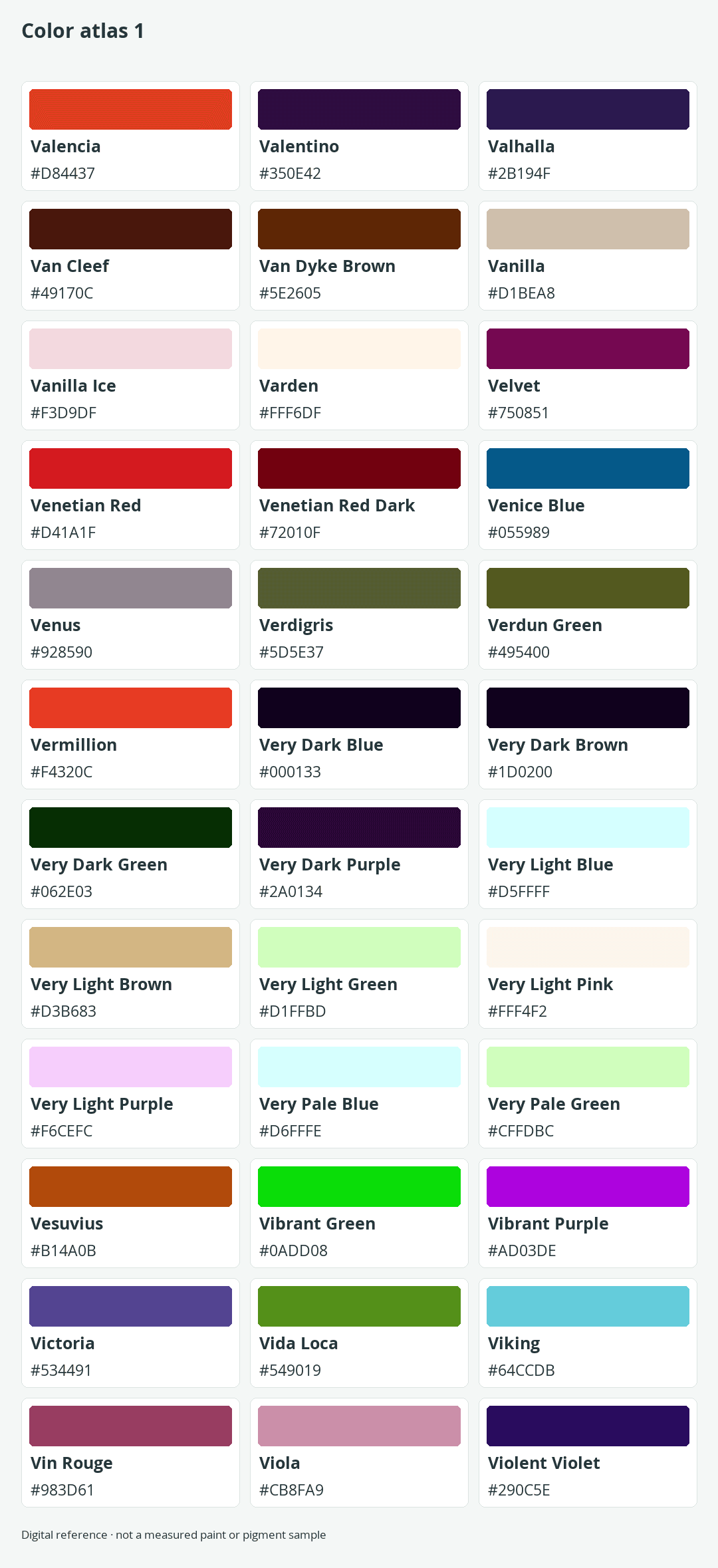
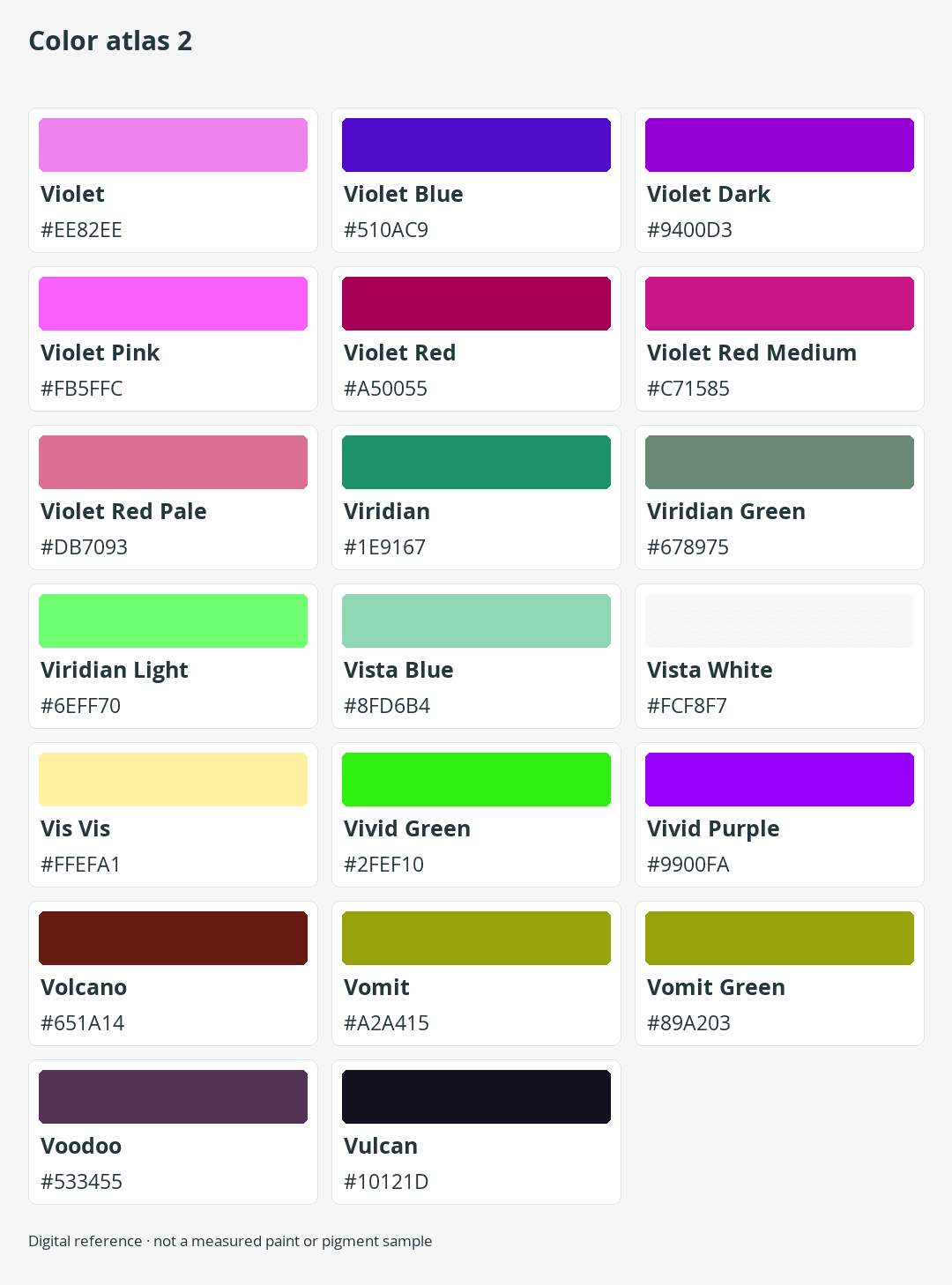
The 56 entries below are ordered alphabetically across all three tables. Each normalized name appears once. Published wording is preserved where it matters, including the survey spelling Vermillion.
Va through Ve
| Name | HEX | RGB | Color | Family | Source/status |
|---|---|---|---|---|---|
| Valencia | #D84437 | 216, 68, 55 | Red | Xona catalog (nonstandard) | |
| Valentino | #350E42 | 53, 14, 66 | Purple | Xona catalog (nonstandard) | |
| Valhalla | #2B194F | 43, 25, 79 | Purple | Xona catalog (nonstandard) | |
| Van Cleef | #49170C | 73, 23, 12 | Brown | Xona catalog (nonstandard) | |
| Van Dyke Brown | #5E2605 | 94, 38, 5 | Brown | Xona catalog (nonstandard) | |
| Vanilla | #D1BEA8 | 209, 190, 168 | Beige | Xona catalog (nonstandard) | |
| Vanilla Ice | #F3D9DF | 243, 217, 223 | Pink | Xona catalog (nonstandard) | |
| Varden | #FFF6DF | 255, 246, 223 | Cream | Xona catalog (nonstandard) | |
| Velvet | #750851 | 117, 8, 81 | Red-purple | Survey-derived | |
| Venetian Red | #D41A1F | 212, 26, 31 | Red | Xona catalog (nonstandard) | |
| Venetian Red Dark | #72010F | 114, 1, 15 | Dark red | Xona catalog (nonstandard) | |
| Venice Blue | #055989 | 5, 89, 137 | Blue | Xona catalog (nonstandard) | |
| Venus | #928590 | 146, 133, 144 | Gray-purple | Xona catalog (nonstandard) | |
| Verdigris | #5D5E37 | 93, 94, 55 | Olive | Xona catalog (nonstandard) | |
| Verdun Green | #495400 | 73, 84, 0 | Green | Xona catalog (nonstandard) | |
| Vermillion | #F4320C | 244, 50, 12 | Red-orange | Survey-derived | |
| Very Dark Blue | #000133 | 0, 1, 51 | Blue | Survey-derived | |
| Very Dark Brown | #1D0200 | 29, 2, 0 | Brown | Survey-derived | |
| Very Dark Green | #062E03 | 6, 46, 3 | Green | Survey-derived | |
| Very Dark Purple | #2A0134 | 42, 1, 52 | Purple | Survey-derived | |
| Very Light Blue | #D5FFFF | 213, 255, 255 | Blue | Survey-derived | |
| Very Light Brown | #D3B683 | 211, 182, 131 | Brown | Survey-derived | |
| Very Light Green | #D1FFBD | 209, 255, 189 | Green | Survey-derived | |
| Very Light Pink | #FFF4F2 | 255, 244, 242 | Pink | Survey-derived | |
| Very Light Purple | #F6CEFC | 246, 206, 252 | Purple | Survey-derived | |
| Very Pale Blue | #D6FFFE | 214, 255, 254 | Blue | Survey-derived | |
| Very Pale Green | #CFFDBC | 207, 253, 188 | Green | Survey-derived | |
| Vesuvius | #B14A0B | 177, 74, 11 | Orange-brown | Xona catalog (nonstandard) |
Vi
| Name | HEX | RGB | Color | Family | Source/status |
|---|---|---|---|---|---|
| Vibrant Green | #0ADD08 | 10, 221, 8 | Green | Survey-derived | |
| Vibrant Purple | #AD03DE | 173, 3, 222 | Purple | Survey-derived | |
| Victoria | #534491 | 83, 68, 145 | Purple | Xona catalog (nonstandard) | |
| Vida Loca | #549019 | 84, 144, 25 | Green | Xona catalog (nonstandard) | |
| Viking | #64CCDB | 100, 204, 219 | Blue | Xona catalog (nonstandard) | |
| Vin Rouge | #983D61 | 152, 61, 97 | Red-purple | Xona catalog (nonstandard) | |
| Viola | #CB8FA9 | 203, 143, 169 | Pink | Xona catalog (nonstandard) | |
| Violent Violet | #290C5E | 41, 12, 94 | Purple | Xona catalog (nonstandard) | |
| Violet | #EE82EE | 238, 130, 238 | Purple | CSS keyword: violet | |
| Violet Blue | #510AC9 | 81, 10, 201 | Blue-purple | Survey-derived | |
| Violet Dark | #9400D3 | 148, 0, 211 | Purple | Xona catalog (nonstandard) | |
| Violet Pink | #FB5FFC | 251, 95, 252 | Pink-purple | Survey-derived | |
| Violet Red | #A50055 | 165, 0, 85 | Red-purple | Survey-derived | |
| Violet Red Medium | #C71585 | 199, 21, 133 | Red-purple | Xona catalog (nonstandard) | |
| Violet Red Pale | #DB7093 | 219, 112, 147 | Pink | Xona catalog (nonstandard) | |
| Viridian | #1E9167 | 30, 145, 103 | Blue-green | Survey-derived | |
| Viridian Green | #678975 | 103, 137, 117 | Green | Xona catalog (nonstandard) | |
| Viridian Light | #6EFF70 | 110, 255, 112 | Green | Xona catalog (nonstandard) | |
| Vista Blue | #8FD6B4 | 143, 214, 180 | Blue-green | Xona catalog (nonstandard) | |
| Vista White | #FCF8F7 | 252, 248, 247 | Off-white | Xona catalog (nonstandard) | |
| Vis Vis | #FFEFA1 | 255, 239, 161 | Yellow | Xona catalog (nonstandard) | |
| Vivid Green | #2FEF10 | 47, 239, 16 | Green | Survey-derived | |
| Vivid Purple | #9900FA | 153, 0, 250 | Purple | Survey-derived |
Vo through Vz
| Name | HEX | RGB | Color | Family | Source/status |
|---|---|---|---|---|---|
| Volcano | #651A14 | 101, 26, 20 | Red-brown | Xona catalog (nonstandard) | |
| Vomit | #A2A415 | 162, 164, 21 | Yellow-green | Survey-derived | |
| Vomit Green | #89A203 | 137, 162, 3 | Green | Survey-derived | |
| Voodoo | #533455 | 83, 52, 85 | Purple | Xona catalog (nonstandard) | |
| Vulcan | #10121D | 16, 18, 29 | Blue-black | Xona catalog (nonstandard) |
How to choose and use a V color
A long color list becomes more useful when you filter by purpose. Start with the broad family, then compare saturation, lightness, neighboring colors, and the surface or screen where the choice will appear.
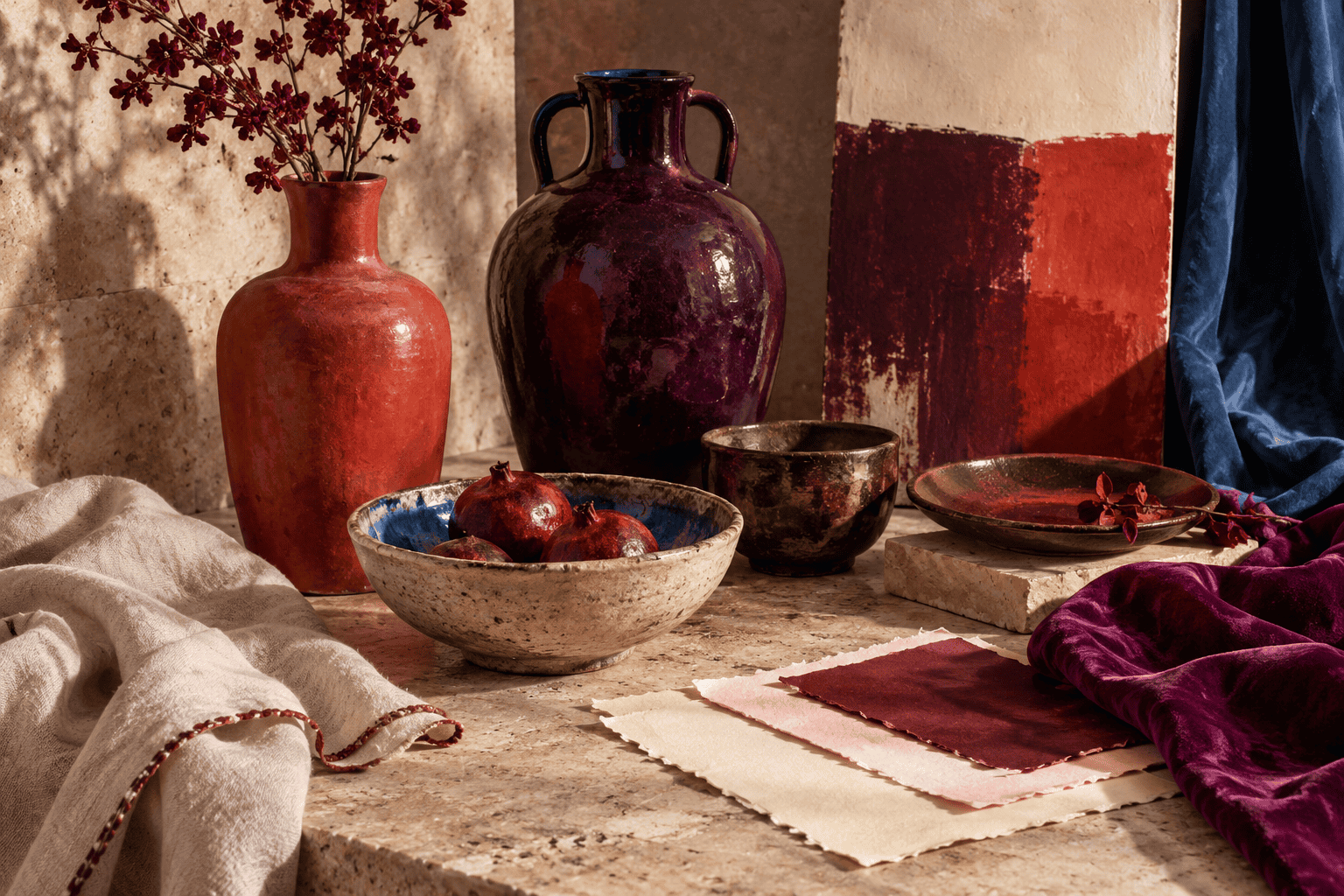 AI-generated editorial illustration; not a measured color sample.
Find a V color by family
- Reds and oranges: Valencia feels warmer and softer than the more saturated Venetian Red and Vermillion. Vesuvius leans brown, while Volcano provides a much darker red-brown.
- Yellows and creams: Varden and Vis Vis suit pale, warm schemes. Vanilla is a quieter beige that can bridge cream, brown, and dusty pink elements.
- Greens and blue-greens: Vibrant Green and Vivid Green are highly saturated accents. Vida Loca and Verdun Green are more grounded yellow-greens, while Viridian, Viridian Green, and Vista Blue move toward cooler blue-green territory.
- Blues: Venice Blue is deep and restrained, Viking is lighter and clearer, and Very Pale Blue or Very Light Blue can serve as airy background candidates.
- Purples and pinks: Valentino, Valhalla, Violent Violet, and Very Dark Purple occupy the dark end. CSS Violet, Violet Pink, Viola, and Vanilla Ice provide progressively softer or pinker options.
- Neutrals and grounding colors: Vista White, Vanilla, Venus, Van Dyke Brown, Very Dark Brown, and Vulcan cover light through nearly black values.
For a room or craft palette, compare the selected HEX swatch with photos of the actual materials rather than ordering paint from the name alone. Lighting, gloss, surface texture, and surrounding colors can change how a physical finish appears.
Check text contrast before committing
Lightness and contrast matter more than a color’s appealing name. Very Dark Blue, Very Dark Brown, Very Dark Purple, and Vulcan are strong candidates for white text. Varden, Very Light Blue, Very Light Green, Very Light Pink, Very Pale Blue, and Vista White are better starting points for black or near-black text. Those extreme light and dark pairings clear the 4.5:1 threshold comfortably, but less obvious combinations should be calculated individually.
For WCAG 2.2 AA, ordinary text needs a contrast ratio of at least 4.5:1. The threshold is 3:1 for text that is at least 18 pt when regular or 14 pt when bold. Do not rely on hue alone to communicate an error, warning, selection, or status; add text, a symbol, a pattern, or another structural cue.
Contrast also depends on the exact foreground and background pair. Viridian may work as a decorative block yet fail with a particular text color, and a border that looks obvious on one screen may disappear for another reader.
Use names as references, not paint recipes
A HEX code describes an sRGB-style screen color, not a physical mixing formula. It does not identify pigments, binders, opacity, tinting strength, sheen, or the color of the surface underneath. Two paint mixtures can look similar under one light and separate noticeably under another.
When matching a digital concept to paint, ink, fabric dye, or another material, treat the HEX value as a visual target. Consult the product’s own sample system, make a test on the intended material, let it dry or cure as directed, and evaluate it under the lighting where the finished work will be seen.
Why the same V color name can have different values
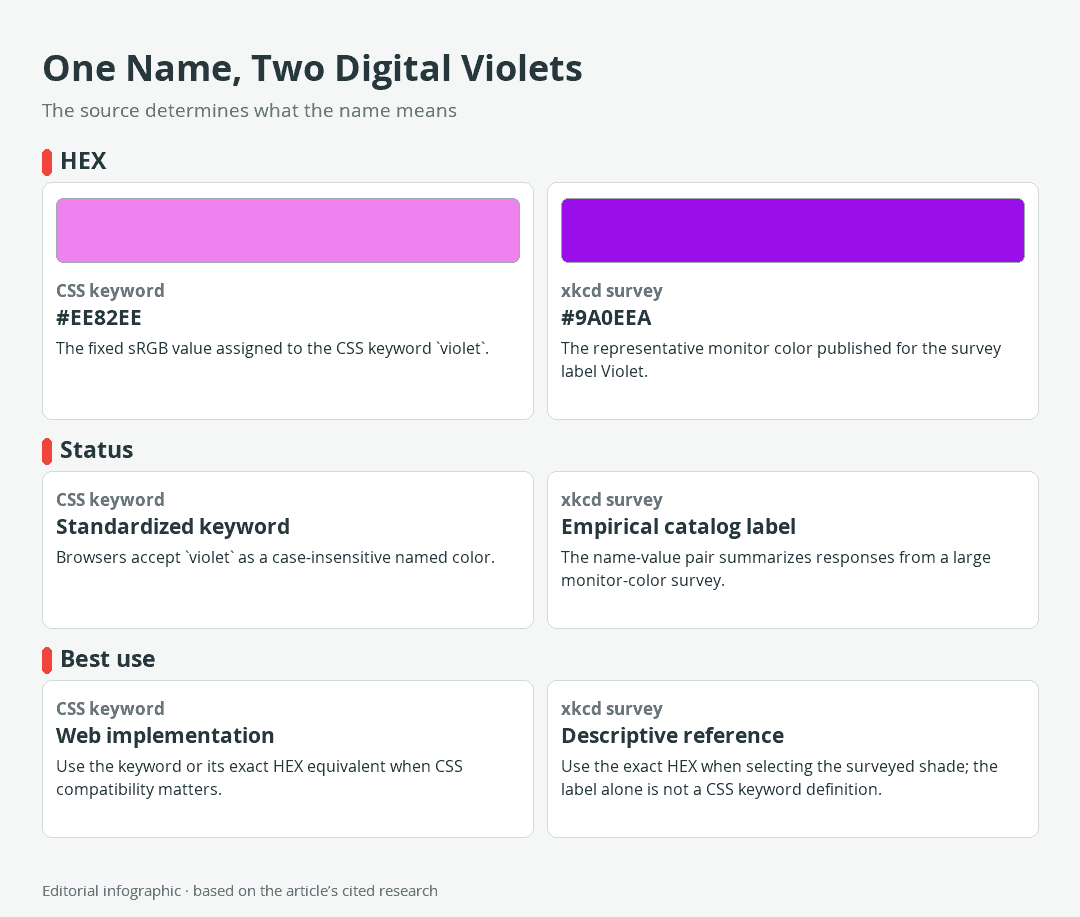
Color names are labels within systems, not coordinates by themselves. Violet makes that distinction especially clear because a browser standard and a survey catalog assign the familiar word to two visibly different digital references.
| Name | HEX | RGB | Color | Status |
|---|---|---|---|---|
| Violet (CSS) | #EE82EE | 238, 130, 238 | Standardized CSS keyword | |
| Violet (xkcd survey) | #9A0EEA | 154, 14, 234 | Survey-derived monitor color |
Violet as a CSS keyword
CSS Violet is fixed at #EE82EE. You can use either violet or the equivalent HEX value in a browser and receive the same sRGB reference. This makes it the practical choice when interoperability and predictable code matter.
Violet as a survey-derived label
The survey value #9A0EEA came from a large collection of responses to colors displayed on monitors. It represents a dense region of agreement among submitted labels, not a replacement for the CSS keyword. Monitor differences and viewing conditions also prevent the survey swatch from becoming an absolute physical definition.
Both values are valid when their systems are stated. They are not interchangeable: the survey Violet is much darker and bluer than CSS Violet.
How to save the value you actually used
Record the source qualifier and the code together, such as “Violet (CSS), #EE82EE” or “Violet (xkcd survey), #9A0EEA.” In a digital project, save the HEX value as a design token or style variable instead of relying on a human-readable name.
Use the same habit with catalog names such as Verdigris, Vanilla, Viridian Green, or Venetian Red. If a collaborator, paint maker, or design application supplies another value, keep that source attached to it. This preserves the chosen appearance without pretending that one descriptive name has a single meaning in every medium and color system.

Learn more about Israel Benloulou and about us.